
The World Will Be Saved By Beauty
May 24, 2015 | Patrick Preheim
Back in 2013 Edna Froese preached the best sermon on Lamentations I have ever heard. In all honesty, though, that was the first and only sermon on Lamentations I have experienced. Lamentations rarely appears in the Revised Common Lectionary (Holy Saturday, Remembrance Sunday Year B, and Proper 27 Year C) using only the most gentle parts of chapter 3—Great is thy Faithfulness. Most preachers typically avoid Lamentations, and I can understand why. Knitting together tattered shreds of hope amidst a hurricane of pain is not easy business. To her credit Edna did a phenomenal job. I would encourage everyone to read or reread that sermon “Speaking our Grief” to learn more of the medium and message of Lamentations. For the sake of time let me share the three gifts of Lamentations which she outlined:
- Poetry, art more broadly I would say, is a Biblical medium of lament.
- Expressing lament may be necessary for there to be future healing.
- Finally, Lamentations assigns the non-griever two actions:
- To unflinchingly bear witness to the lament.
- To consider how the suffering might be redeemed.
This morning I will offer examples of ways in which the arts have given a language for grief in the wake of catastrophe. The case studies will suggest the way in which this artistic expression has or might lead to healing. And as I subject us to modern day expressions of Lamentations we will bear unflinching witness and considering our part in God’s redemption of suffering. So, let us give modern day Lamentations a try, shall we?
In a minute or two I will show the trailer for the “Singing Revolution”. Singing truly is one of the arts. It is a gift of our Creator which allows expression of our pain. It carves out space for healing. It has the power to redeem. “After 50 years of rule by the oppressive Soviet regime, the people of Estonia gave life to a grassroots movement for change by staging passionate rallies and singing forbidden patriotic songs. James and Maureen Castle Tusty's moving documentary recounts Estonia's fight for independence from Soviet occupation, telling the remarkable story of the hundreds of thousands of protesters who gathered in public to voice their dissent through song. The movie concentrates on acts of peaceful defiance of Estonians against their Russian occupiers through peaceful protest...The story is one of the step-by-step reestablishment of Estonian independence without violence and through mass demonstrations of unity and singing” (Synopsis taken from IMDB).
Show Singing Revolution movie trailer
Estonia—what a noble country filled with pacifist singers. It almost sounds like the kind of place I could live. To be honest, though, I like Canada. And wouldn’t you know it but there is a Lamentations re-enactment happening among us even as we speak. The TRC (Truth & Reconciliation Commission ) is a powerful poetic response to the tragedy of Residential Schools.
Slide: TRC Logo

In many ways the TRC fits the trinitarian lesson of Lamentations: an artistic expression of grief intended to promote healing and inviting potential responses from the witnesses. The next series of images reflect on the TRC process over the last six years and the bulk of text I will read comes from Mark Kennedy’s article in the Ottawa Citizen which was reprinted in The Saskatoon StarPhoenix (May, 25, 2015 Section B5).
“Canadians must acknowledge that for generations, their public schools have fed them misinformation about aboriginal people, says the chairman of the...TRC.
Slide: Murray Sinclair

Justice Murray Sinclair, whose commission has examined the history and abuses that took place in Indian residential schools, made the comment in a personal interview with the Ottawa Citizen. Sinclair’s commission has finished six years of hearings and research and will publicly release its findings in Ottawa on June 2.
Slide: They Came For the Children
The TRC’s report will provide a detailed account of how 150,000 aboriginals were stripped from their families starting in the 1880s and sent to church-run schools established by the federal government. The last residential school closed in the 1990s.
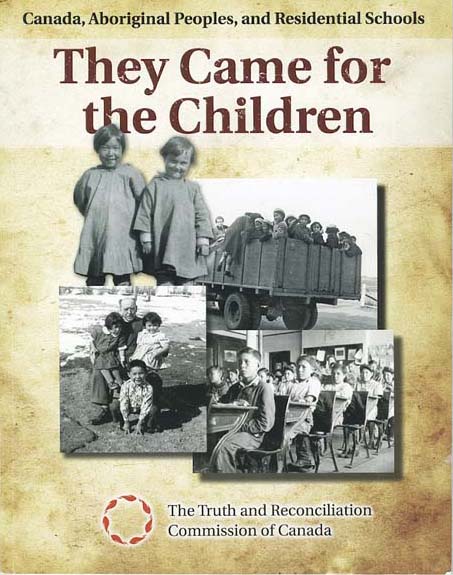
Slide: Children in Residential School
The report will chronicle the abuse many faced, and how the system scarred several generations of aboriginals, leaving their communities in shambles. But Sinclair emphasized that one of the most important messages that will come from the report is that the consequences of the school system are far more wide-reaching than many realize.
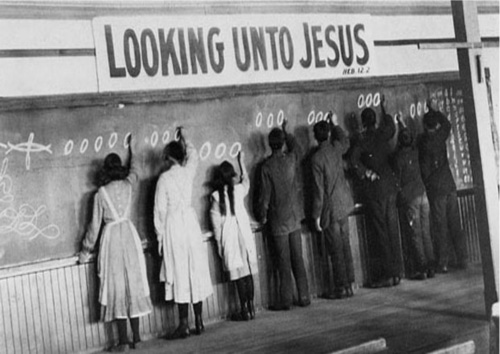
“This is not an aboriginal problem,” he said. “This is a Canadian problem. Because at the same time that aboriginal people were being demeaned in the schools and their culture and language were being taken away from them and they were being told that they were inferior; [that] they were pagans, that they were heathens and savages and that they were unworthy of being respected—that very same message was being given to the non-aboriginal children in the public schools as well. As a result, he said, many generations of non-aboriginal Canadians have had their perceptions of aboriginal people “tainted”...We needed to be sure that people were brought to the table of knowledge about this in a way that didn’t scare them, didn’t push them away, didn’t make them feel ashamed or guilty or that they were to blame. But they needed to see that they were victims, too, of this history.”....
Slide: Centennial Flame
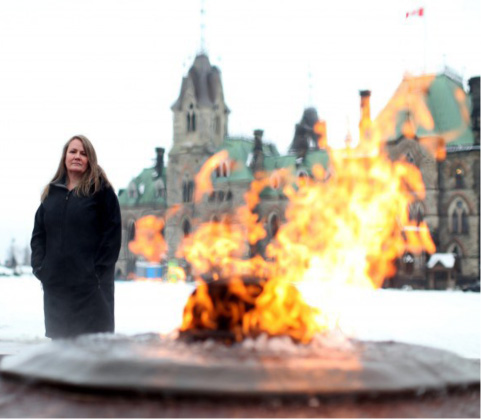
The commission was established as part of a class-action lawsuit settlement between residential school students and the federal government and churches. It was money from this settlement, the victim’s money, which has largely financed the TRC sessions throughout the country. In their pain the victims of the residential schools have crafted this beautiful, this artistic, process so that both the aboriginal and non-aboriginal communities might experience healing. Is this not the epitome of Christ-likeness to extend an offer of healing to victim & perpetrator alike?
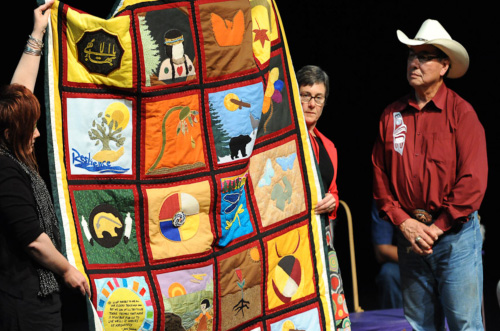
Slide: Quilted Blanket
“Sinclair said he often tells people, “This is about your grandchildren...because we’re leaving them this society. And do we want to leave them a society in which they are always in conflict? Or do we want to leave them a society in which they see themselves as partners in this wonderful nation that we want to have, but we don’t yet have”. End Mark Kennedy quote. Residential schools have been one of our greatest national tragedies: it broke down our aboriginal siblings and tainted our souls. The TRC process, like Lamentations, leaves potential responses up to us. How shall we live knowing now what we know? [30 second pause]
Slide: Make Humus Not Walls
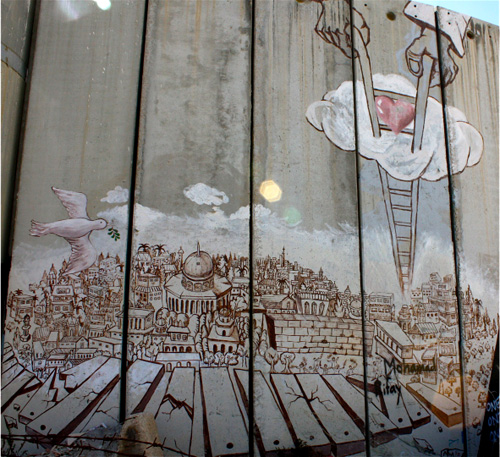
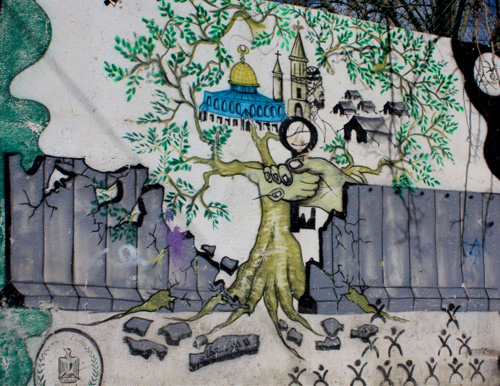
The next set of slides will proceed largely without comment. They all come from the Holy Land. The European holocaust is a burden with which Jews live; approximately 6 million were killed. In Arab circles the Nakba is the 1948 national tragedy in which 700,000 Palestinians were expelled from their homes to make room for Jewish immigrants to the newly created state of Israel. Both peoples have used the arts to give voice to their pain. Elements within each nation wish this art would contribute to the healing of the nations. The images comes from the Holocaust Memorial Grounds called Yad Vashem in Israel and graffiti art painted on the illegally constructed Green Line Wall which separates Palestine from parts of Palestine and Israel.
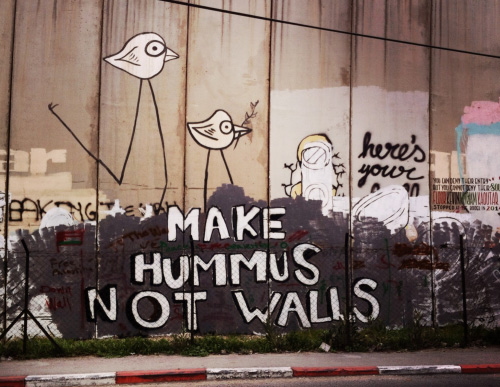
Slide: 2nd Wall side [30 seconds]
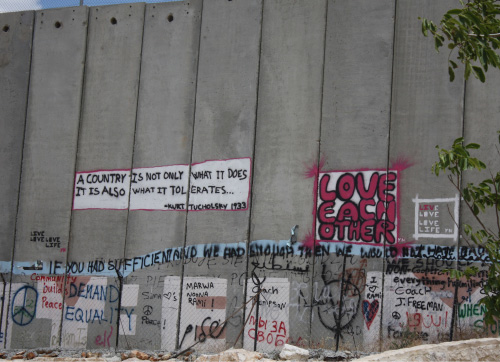
Slide: Father holding Children [30 seconds]
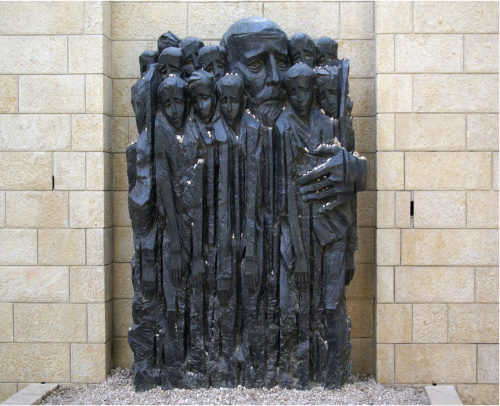
These next two slides come from Yad Vashem.
Slide: Human Fence [30 seconds]
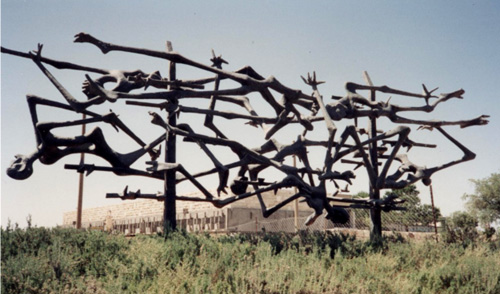
Slide: West Jerusalem Ladder with Heart [30 seconds]
Slide: Olive Tree breaks Wall [30 seconds]
Slide: Righteous Gentile Trees [stay on till the end]
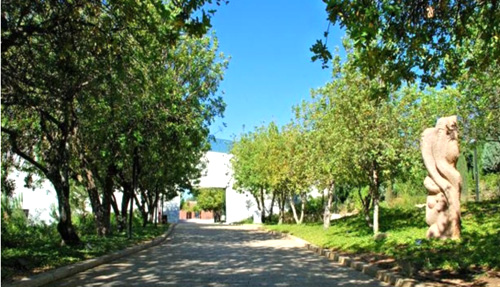
This is a picture of Yad-Vashem-Avenue. It captures an image of trees planted in honour of Righteous Gentiles who saved Jews during the Holocaust. Oskar Shindler, who many will know from Steven Spielberg’s movie Shindler’s List, has a tree planted in his memory as does Swede Raol Wallenberg for whom a day in Canada has been set aside (Jan 16). In addition to these men who saved thousands there are trees planted for secretaries and janitors who helped save dozens. Tree art appeals to me. Trees are alive, as I hope is the Spirit of these who allowed lament to motivate them to humanitarian action on their blocks, in their businesses, in their nations.
Screen Closed
I hope seeing these images and reflecting on Lamentations will make a difference for us. My hoped for application to the book of Lamentations? Well....
- I want us to be a people who own the lamentations around us and convert them to poetry, to song, to prayer blankets, to graphic art, to organic art. I want us to be a people whose artistry convicts the world. I want God to make beauty through us which might save the world.
- I want us to be a congregation of Righteous Gentiles who stand alongside those who are lamenting. In business, block, and community how might we actively stand alongside those who are suffering? When the suffering can not stand, will we sit with them?
- I want us to acknowledge our universal and eternal God. God cares about us. God cares about all who suffer. God’s Spirit is on the move working redemption to suffering. This is what God does. Our task is to partner with our Lord and Saviour. May have the vision to see what God is doing and courage to join in.
Amen.
